
Choosing the Right Business Entity: S Corp, Partnership, or C Corp?

Updated: Jul 31

Choosing the right business structure is one of the most important decisions a business owner can make. The entity you choose can affect how your business is taxed, how profits and losses are allocated, how owners are compensated, and the level of administrative complexity required to operate the business.
While S corporations, partnerships, and C corporations are all common types of entities, they differ significantly in taxation, ownership flexibility, and compliance requirements.
At a high level, S corporations and partnerships are both considered pass-through entities, meaning the business generally does not pay federal income tax at the entity level. Instead, profits and losses pass through to the owners and are reported on their individual tax returns.
C corporations, by contrast, are taxed separately from their owners. The corporation pays tax on its earnings, and shareholders pay tax again when profits are distributed as dividends. This is commonly referred to as double taxation.

Key Tax Differences
One of the biggest differences between these entities is how income, losses, and deductions are treated.
Because S corporations and partnerships are pass-through entities, owners may be eligible for the Qualified Business Income (QBI) deduction, which can allow a deduction of up to 20% of qualified business income, subject to certain limitations. C corporations are not eligible for this deduction.
When it comes to losses, both S corporation shareholders and partners may be able to use business losses to offset other income on their personal tax returns. However, these deductions are limited. For S corporations, losses are generally limited to the amount the owner has invested in the business or personally loaned to it.
Partnerships are often more flexible in this area because an owner’s tax basis can include their share of partnership debt. This can allow partners to deduct more losses compared to S corporation shareholders. However, partnership losses are still subject to basis, at-risk, and passive activity limitations.
Another key difference is payroll and self-employment taxes. S corporation owners are required to pay themselves a reasonable salary, which is subject to payroll taxes, but additional profits may not be. In contrast, income allocated to active partners is generally subject to self-employment tax. C corporation owners pay payroll taxes on wages they receive, while dividends paid are not subject to those taxes but are taxed separately.

Owner Pay & Tax Impact
How owners are paid varies significantly between entity types and directly impacts overall taxes.
S corporation owners typically receive a combination of salary and profit distributions. The salary portion is subject to payroll taxes, while distributions are generally not. When structured appropriately, this can create payroll tax savings compared to other entity types.
In a partnership, owners usually do not receive a salary. Instead, they receive their share of the business’s profits, and in most cases, income allocated to active partners is subject to self-employment taxes. This can result in a higher overall tax burden compared to an S corp.

C corporation owners may receive both wages and dividends. Wages are subject to payroll taxes, while dividends are taxed separately at the individual level. This creates a different mix of taxation compared to pass-through entities.
Flexibility & Ownership
Another major difference among these entity types is the level of ownership flexibility and the ability to customize economic arrangements among owners.
Partnerships offer the greatest flexibility. They allow for multiple types of owners and can allocate profits and losses in different ways, as long as there is a valid business purpose. This makes them a strong option for businesses with multiple owners who want customized arrangements.
S corporations are the most restrictive. They limit the number and type of shareholders and only allow one class of stock, meaning economic rights generally must be proportionate to ownership percentages.
C corporations have the fewest ownership restrictions. They can have unlimited shareholders and multiple classes of stock, making them the preferred structure for businesses seeking outside investors or planning significant growth.
Complexity & Risk
Each entity type comes with its own level of complexity and potential risk.
Partnerships often have the most complex tax rules due to basis calculations, debt allocations, and specialized profit-sharing arrangements. S corporations require strict compliance with shareholder eligibility rules, payroll requirements, and careful tracking of shareholder basis. C corporations involve separate tax filings and greater corporate formalities but avoid many of the allocation and ownership limitations of the other structures.
Businesses frequently operate multiple entities for liability protection, tax planning, or operational purposes. As those entities interact, owners often transfer funds between related businesses, creating additional tax and compliance considerations.
A November 2024 article in The Tax Adviser highlighted the risks associated with loans between commonly owned entities. If a purported loan lacks formal documentation, repayment terms, interest provisions, or a clear business purpose, the IRS may recharacterize the transaction as an equity contribution rather than debt. In certain situations, this reclassification can result in unexpected tax consequences, including constructive dividend treatment. Proper loan agreements, repayment schedules, and contemporaneous documentation are critical to supporting the intended tax treatment.
In general, the more flexibility a business structure provides, the more important it becomes to maintain accurate records and comply with applicable tax and legal requirements.
When Each Structure Makes Sense
The best entity choice depends on your specific business goals and situation.
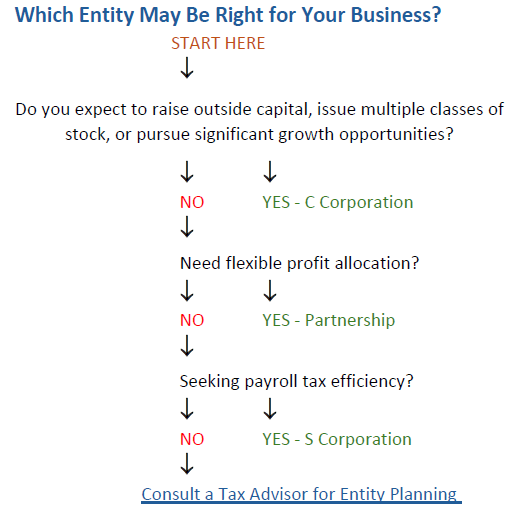
C corporations are typically best suited for businesses that plan to grow, reinvest profits, or bring on outside investors. Because the corporation is taxed separately, earnings can remain in the business to support future growth rather than passing through to owners and being taxed at the individual level each year.
Partnerships are commonly used for businesses with multiple owners who want flexibility in how profits, losses, and responsibilities are shared, though the tax rules can become more complex over time.
S corporations are often a good fit for profitable small to mid-sized businesses looking for potential payroll tax efficiency, provided they are willing to meet the additional compliance requirements.
Making the Right Entity Choice
There is no one-size-fits-all answer when choosing a business entity.
An S corporation may offer payroll tax efficiencies for certain profitable businesses, a partnership may provide valuable flexibility for multiple owners, and a C corporation may be the preferred structure for companies seeking outside investment or long-term growth.
Working with a qualified tax advisor can help ensure your entity choice aligns with both your current operations and your future business strategy. Whether you're starting a new business, considering

a change in entity structure, or looking for additional tax-saving opportunities, our team is here to help. Contact us at jessica@fpgtax.com or (816) 941-2900 to schedule an appointment with one of our CPAs.



Comments